
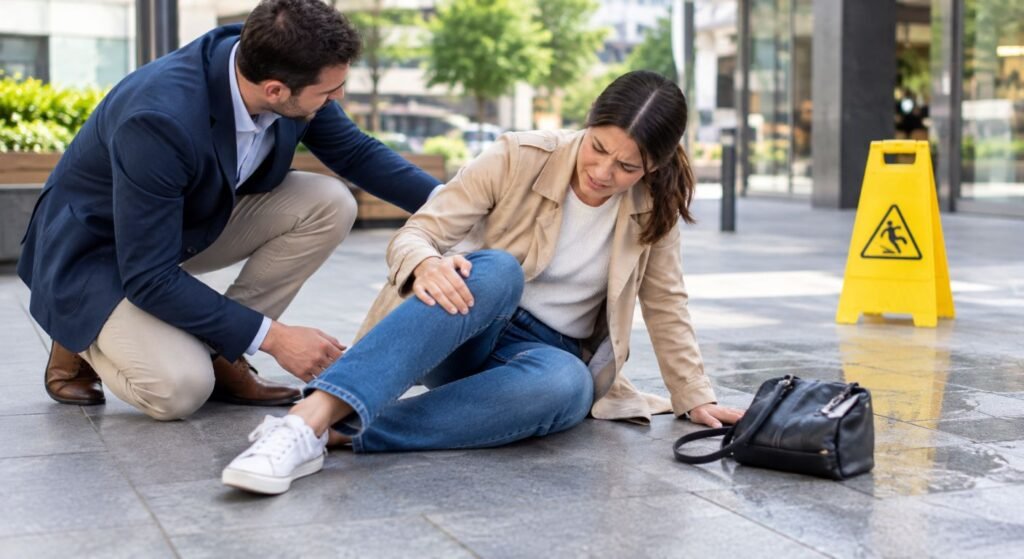
Yes, you can claim compensation for an injury in a public place in Perth if a council, business or property owner failed to take reasonable care and that failure caused your injury. Whether you tripped on a broken footpath or slipped on a wet shop floor, a public place injury lawyer Perth can help you work out if you have a valid claim.
Injuries in public places such as footpaths, shopping centres and car parks are more common than many people realise, and even a minor fall can result in medical expenses, lost income and ongoing pain. Under Western Australian law, the party who occupies or controls the area, which may include a council, business, or property owner must take reasonable care to avoid foreseeable risks of harm. Where that duty is breached and you are injured as a result, you may be entitled to compensation. This article explains what you must prove, who may be liable, what compensation can cover, the time limits that apply and the steps to take after an accident.
Key Takeaways
- Yes, you may claim compensation if a council, business or property owner failed to take reasonable care, causing your injury.
- A successful public liability claim requires proof of three legal elements: duty of care, breach of that duty and causation.
- Your compensation may be reduced if you were partly responsible for the accident or if the risk was reasonably obvious.
- Adults generally have three years from the date of injury to commence court action, so early legal advice is important.
- After an accident, seek medical attention promptly, report the incident, photograph the hazard, collect witness details and keep all receipts.
What Counts as a Public Place Injury?
An example of public liability occurs when you suffer an injury on property where another person or entity occupies or controls the area. This can include privately owned premises that are open to visitors, such as shopping centre, supermarket, restaurant, hotel or event venue.
Common examples in Perth include:
- Tripping on uneven or cracked footpaths
- Slipping on spills in supermarkets, shopping centres or restaurants
- Falling because of poor lighting, loose flooring or damaged stairs
- Injuries from unsafe playground, gym or pool equipment
- Being struck by stock or fittings falling from shelves
Workplace injuries and motor vehicle accidents are handled under separate claims schemes.
What Do You Need to Prove?
The laws in Western Australia that deal with public liability claims include the Civil Liability Act 2002 (WA) and the Occupiers’ Liability Act 1985 (WA). There are three elements that you generally need to prove:
- Duty of care – A duty to take reasonable care for your safety was owed to you by the other party.
- Breach – They failed to meet that duty, for example by not taking reasonable precautions against a foreseeable risk. This may include failing to act on a hazard they knew about or ought to have known about.
- Causation – Their breach must have caused your injury. This requires proving that the harm would not have occurred but for the breach, and that it is appropriate for the scope of their responsibility to extend to that harm.
If the risk was not reasonably foreseeable, or sensible precautions were taken, the claim may not succeed.
Who Could Be Liable for Your Injury?
Based on the location where the accident took place, the responsible party might be the local council, shopping centre owner or manager, retailer, hotel proprietor, event organizer, a government department, or another occupier or controller of the area. A landlord or contractor may also be involved, but liability is not automatic and depends on who had control of the relevant area and responsibility for the particular risk.
These statements may be more complex because of the provisions of the Civil Liability Act, which require the court to consider the limited resources and competing responsibilities of a public authority, and may also provide statutory protections in some circumstances. In footpath and road related cases in particular, whether a council or roads authority is liable can depend on factors such as whether the risk was foreseeable and whether the authority had actual knowledge of the specific hazard. In some cases, two parties may be at fault. For instance, where a person trips in a shopping centre, it could be the owner and the company contracted for the floor cleaning. Working out who controlled the area and what each party knew or should have known about the hazard helps direct your claim to the right party.
What Can Public Liability Compensation Perth Cover?

Compensation aims to put you, as far as money can, in the position you would have been in had the injury not happened. If your claim succeeds, it may include:
- Medical, hospital and rehabilitation expenses
- Past and future loss of income or earning capacity
- Care and domestic assistance provided by others
- Travel costs linked to treatment
- General damages for pain, suffering and loss of enjoyment of life
Western Australia law restricts recovery of general damages for non-economic loss (pain, suffering and loss of enjoyment of life) by applying a threshold of seriousness in many cases, and the amount (if any) is assessed by reference to the statutory scale. Every matter is assessed on its own facts, and no outcome can be guaranteed.
How Long Do You Have to Make a Claim?
Under the Limitation Act 2005 (WA), adults generally have a three-year limitation period to commence court action, but when that period starts can depend on the circumstances (including when the injury and its cause were discoverable). Special provisions apply for children.
A child under 15 at the time of the injury has six years, and a 15- to 17-year-old, at the time of the injury, has until they reach 21. You might lose the right to claim altogether if the process is not initiated in time. In some cases, courts may extend the time period, but this is not something to rely on.
As evidence, including videotapes and witness recollections, fades with the passage of time, it is best to get some advice early.
Factors That Can Affect Your Claim
When someone else was clearly at fault, it does not always turn out to be easy. Insurers pay close attention to all the details, and there are several problems that can make a claim worth less or even worthless:
- Contributory Negligence: If you share in the fault, the compensation you’re entitled to may be limited.
- Obvious Risks: There are obvious risks and the law places a restriction on liability for obvious risks.
- Limited Evidence: If there are no photos or witnesses, it will be harder to prove what happened.
- Buildup of Symptoms: Your symptoms can be attributed to a previous injury by current insurance carriers.
Steps to Take After an Injury in a Public Place
What you do soon after an accident can shape your claim. The following tips will ensure that your well-being is safeguarded as well as evidence preserved:
- See a doctor promptly and follow their treatment advice.
- Report the incident to the owner or manager and ask for a copy of the report.
- Photograph the hazard, the surrounding area and your injuries.
- Collect the contact details of any witnesses.
- Keep receipts, payslips and records of time off work.
- Avoid admitting fault or signing insurer documents before getting legal advice.
Why Speak With a Public Place Injury Lawyer Perth?
The insurance company representing the council or business typically deals with public liability claims. A competent personal injury lawyer Perth will identify liability, collect evidence, obtain independent medical statements, determine damages and advocate for you.
A lawyer can also assist with handling all communication with insurance companies, which allows you to concentrate on your recovery while your case progresses. While many claims settle before trial, it’s a good idea to be ready to take it all the way.
Conclusion
A public place injury can impact your health, income, and daily routine. The earlier you act, the better your records are and the more you know about time limits, the better off you will be. It also enables you to make informed decisions from the start by receiving advice that is specific to your situation.
MPK Lawyers work with injured individuals throughout Perth to ensure that they know their rights and receive fair outcomes. Our team takes the time to listen, explain your options clearly and guide you at each stage. If you are unsure where you stand, speaking with a public place injury lawyer in Perth is a sensible first step.
Frequently Asked Questions
1. Can I sue the council if I trip on a footpath in Perth?
Yes, if the council was aware or should have been aware of the hazard and did not act reasonably. The council’s priorities and resources are taken into account by courts; claims must be carefully substantiated and advised.
2. How much compensation can I get for a public liability claim in WA?
There is no fixed amount. The amount of compensation will depend on the severity of the injury, the impact on your working and living life, your costs and whether there are general damages that meet the legal threshold.
3. Can I still claim if I was partly at fault?
Often, yes. Your claim may continue even if you are partially responsible, but may be reduced to reflect your role. This is referred to as contributory negligence under WA Law.
4. How long do I have to make a public liability claim in WA?
It is typically 3 years for adults from the time of injury to begin proceedings. Children have special time limits, and early legal advice will ensure that you have the right to claim.
5. What evidence do I need for a public liability claim?
Photos of the hazard, incident report, witness information (not mandatory), medical records, and receipts are useful evidence. CCTV footage can also be helpful, but is often erased from storage soon after, so ask for it right away.
Get Advice on Your Injury Claim
Book a free consultation with an experienced personal injury lawyer in Perth today for clear advice on your rights and next steps.